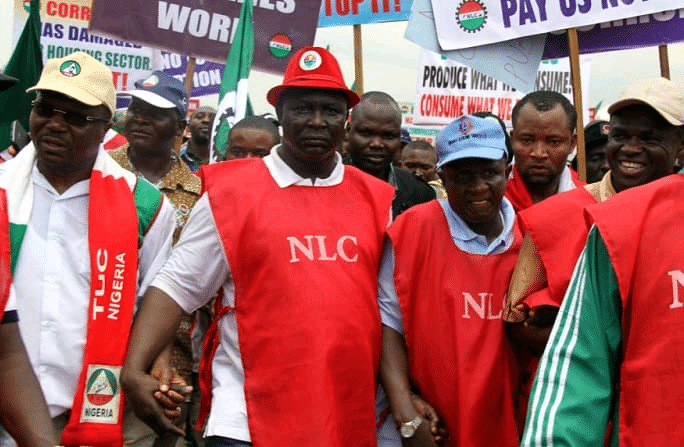
The Nigeria Labour Congress has reaffirmed its two-week ultimatum to the Federal Government over rising petrol prices and demands for fresh minimum wage negotiations, warning that Nigerian workers are struggling to afford food and transportation despite the N70,000 national minimum wage.
NLC President, Joe Ajaero, stated this on Monday in Abuja, urging the government to take urgent measures to ease workers’ economic hardship before the situation escalates into industrial action.
Ajaero said the current economic conditions had significantly weakened workers’ purchasing power, arguing that the minimum wage agreed upon in 2024 was no longer sufficient to meet basic household needs amid rising living costs.
The labour leader spoke at a retreat involving officials of the National Salaries, Incomes and Wages Commission, where he called on the government to address workers’ concerns proactively rather than wait for protests or strikes.
“I’ve not come here to discuss my ultimatum. My ultimatum stands. I’ve said something about it, and this is not a table. The fact that the permanent secretary is here does not give us the opportunity to start negotiating an ultimatum. He has replied a letter, and we have replied him again. So, we will go into that game,” Ajaero said.
He added, “But to the head of service, sir, Nigerian workers are really suffering. And if you do something, history and posterity will remember all of us for it.”
The NLC had issued a two-week ultimatum demanding a reduction in petrol prices and the commencement of fresh negotiations on the national minimum wage, citing the impact of rising transportation and food costs on workers’ earnings.
Ajaero said the hardship had become so severe that many workers could no longer comfortably meet basic needs.
“The point we are making is not strike. The point we are making is that whether you enter bus or you buy fuel, you will not be able to eat,” he said.
He urged the Federal Government to introduce relief measures before labour unions were compelled to mobilise workers for industrial action.
“But to wait for Labour to be on the street before we address this is not really what is happening all over the world. Countries all over the world will come with interventionary measures even before Labour acts on it. I think we should be more proactive,” he said.
NLC disputes salary increase figures
The labour leader also challenged claims that the 2024 minimum wage negotiations had resulted in salary increases of about 133 per cent for federal public servants.
According to Ajaero, the government added N40,000 to workers’ salaries, an adjustment he said did not justify the percentage increase being attributed to the wage agreement.
“After the last minimum wage negotiation, which some of you have been arguing that it attracted about 133 per cent increase, what the head of service—what they did was adding 40,000 to every worker. That’s not the real way to negotiate,” he said.
“All the federal public service workers, they added 40,000 to them. 40,000 does not translate to 100 per cent or 133 per cent. And the consequences are what we are facing now.”
Ajaero maintained that the salary adjustment had failed to provide sufficient relief as inflation and transportation costs continued to put pressure on household budgets.
He also raised concerns over unresolved industrial disputes, recalling an 84-day strike by health sector workers that was suspended following the intervention of organised labour.
According to him, more than a year after the intervention, the issues that triggered the strike had yet to be adequately addressed.
He further disclosed that workers under the National Public Service Negotiating Council had considered industrial action but were persuaded by labour leaders to suspend their plans.
Rejecting suggestions that organised labour was being influenced by politicians, Ajaero said the union’s demands were driven by workers’ welfare.
“No politician can use us. That’s the greatest insult, to tell me at this age and time, you know, to say a politician is using you when you ask for increase of workers’ salaries,” he said.
He appealed to government officials and the leadership of the wages commission to take workers’ concerns seriously and pursue meaningful solutions to prevent further deterioration in industrial relations.
FG calls for balance between workers’ welfare and fiscal realities
Meanwhile, the Secretary to the Government of the Federation, George Akume, called for a balance between workers’ demands for improved remuneration and the government’s financial capacity.
Akume, represented by the Permanent Secretary in the Office of the Secretary to the Government of the Federation, Dr Abubakar Kana, said wage decisions must reflect economic realities while supporting industrial harmony and national development.
“The commission must continually balance the legitimate expectations of workers with the fiscal realities of government and broader imperatives of national economic development,” he said.
He noted that economic reforms, rising public expectations and the approaching 2027 general elections had made the development of a fair and sustainable wage system increasingly important.
Akume urged the commission to strengthen policy coordination, improve data management and consult organised labour, employers and other stakeholders when making recommendations on wages.
He also warned against avoidable industrial disputes, stressing the importance of dialogue and cooperation.
“A credible and inclusive approach towards governance is indispensable to building trust, preventing avoidable industrial disputes like we’re about to have now, and promoting a stable environment for national development,” he said.
The Chairman and Chief Executive Officer of the National Salaries, Incomes and Wages Commission, Junaidu Bindawa, said the country’s economic conditions required a strategic approach to wage administration.
Bindawa said inflationary pressures, changing labour expectations and the need for greater public sector efficiency had increased the importance of sustainable salary policies.
He noted that wage administration affected workers’ welfare, public expenditure, industrial relations and the overall performance of the civil service.
“Our work must reflect a careful balance between the legitimate expectation of workers, the imperatives of productivity and social justice, and the physical capacity of government,” he said.
Bindawa explained that the commission’s retreat, themed Vision, Strategy and Institutional Renewal, was designed to improve its capacity to address emerging wage and compensation challenges.
He called for stronger research, improved job evaluation, effective compensation management and greater institutional accountability.
The commission’s Secretary, Olajumoke Okoya-Thomas, also advocated a permanent, data-driven approach to wage reviews rather than one driven by emergencies.
“We exist so that wage decisions rest on evidence, not emergencies,” she said.
She noted that the 2024 minimum wage more than doubled the previous statutory minimum but stressed that future wage decisions must remain fair, evidence-based and financially sustainable.
Head of Service backs civil service reforms
The Head of the Civil Service of the Federation, Abel Enitan, said improving workers’ welfare, institutional efficiency and public service delivery was essential to national development.
He said the government was prioritising staff development and the digitisation of civil service operations, with the aim of establishing a fully paperless working environment.
Enitan also linked public service reforms to President Bola Tinubu’s ambition of building a $1tn economy by 2030, arguing that the target would require a productive and well-equipped workforce.
“It is achievable. Just that the workforce must be mobilised behind that agenda,” he said.
He expressed confidence that the retreat would produce recommendations to strengthen wage administration, improve workers’ welfare and enhance public service performance.