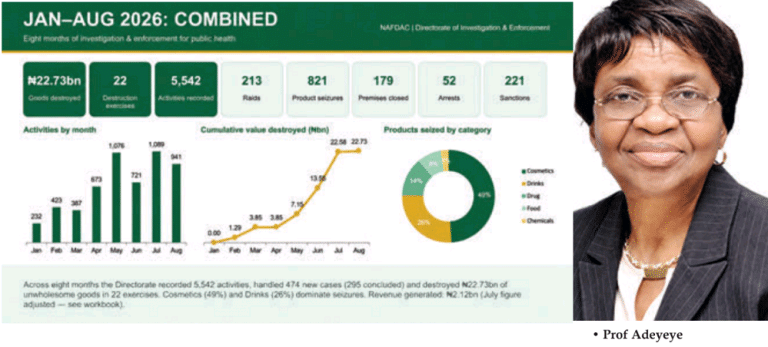
The National Agency for Food and Drug Administration and Control (NAFDAC) destroyed unsafe, falsified and non-compliant products valued at N22.73 billion between January and August 2026, as the agency intensified its enforcement campaign against products posing risks to public health.
The agency recorded 5,542 enforcement activities, conducted 213 raids, documented 821 product seizure entries and closed or sealed 179 premises during the eight-month period. It also made 52 arrests, imposed administrative sanctions, opened 474 new cases and concluded 295 cases.
The figures, obtained from NAFDAC’s Directorate of Investigation and Enforcement, highlight the scale of the agency’s regulatory interventions across Nigeria’s food, pharmaceutical, cosmetics, medical devices, packaged water, beverages and chemical sectors.
The enforcement operations were conducted under the leadership of the agency’s Director-General, Prof. Mojisola Adeyeye, with the Directorate of Investigation and Enforcement headed by Dr Martins Iluyomade, who also chairs the Federal Task Force on Counterfeit and Fake Drugs and Unwholesome Processed Foods in Nigeria.
A breakdown of the monthly figures shows that enforcement activities gathered momentum as the year progressed, with July recording the highest number of activities and the largest monthly value of products destroyed.
In January, NAFDAC recorded 232 enforcement activities, conducted 20 raids, closed or sealed seven premises and made eight arrests. Drinks accounted for 83 activities, while drugs accounted for 60. The agency imposed 19 sanctions and concluded 10 cases out of 35 newly reported cases.
Enforcement activities increased to 423 in February, alongside 36 raids, 47 premises closures or seals and 11 arrests. The agency imposed 17 sanctions and concluded 19 cases out of 55 newly reported cases. It also conducted a destruction exercise involving products valued at N1.29 billion.
In March, the agency recorded 387 enforcement activities, conducted 20 raids, closed or sealed nine premises and imposed 18 sanctions. It concluded 43 cases and carried out two destruction exercises involving products worth N2.56 billion, bringing the cumulative value of destroyed goods to N3.85 billion by the end of the month.
April saw a further increase in enforcement operations, with 673 activities, 46 raids and 94 product seizure entries recorded. NAFDAC closed or sealed 32 premises, made seven arrests and imposed 26 sanctions.
Cosmetics accounted for the highest number of activities in April, at 272, followed by food products with 183.
The agency recorded 1,076 enforcement activities in May, making it one of its busiest months during the period. Although it conducted six raids, it documented 90 seizure entries, closed or sealed 18 premises and imposed 35 sanctions.
Five destruction exercises involving products valued at N3.30 billion were carried out in May, increasing the cumulative value of destroyed goods to N7.15 billion. Chemicals accounted for 396 enforcement activities, while cosmetics accounted for 219.
In June, NAFDAC recorded 721 enforcement activities, conducted 35 raids and documented 165 seizure entries. Nine premises were closed, seven arrests were made and 20 sanctions imposed.
Eight destruction exercises involving goods worth N6.40 billion brought the cumulative value of destroyed products to N13.55 billion.
July recorded the highest monthly enforcement activity and destruction value during the eight-month period.
The agency carried out 1,089 enforcement activities, conducted 22 raids and recorded 240 product seizure entries. It also closed or sealed 37 premises, made 12 arrests and imposed 49 sanctions.
During the month, NAFDAC concluded 59 cases out of 97 newly reported cases. Four destruction exercises involving products valued at N9.03 billion were conducted, raising the cumulative value of destroyed goods to N22.58 billion.
In August, the agency recorded 941 enforcement activities, 28 raids and 232 product seizure entries. It closed or sealed 20 premises, made three arrests and imposed 37 sanctions.
NAFDAC also concluded 69 cases against 61 newly reported cases during the month. Two destruction exercises involving products valued at N157.7 million brought the cumulative value of destroyed products to N22.73 billion.
A breakdown of the 821 product seizure entries recorded during the period shows that cosmetics accounted for the largest share, with 401 entries.
Drinks followed with 215 entries, while drugs accounted for 112. Food products recorded 69 entries, while chemicals accounted for 22.
The figures reflect the broad range of regulated products targeted by the agency, extending beyond counterfeit medicines to include unsafe cosmetics, improperly manufactured beverages, adulterated food products, hazardous chemicals and other goods that fail to meet prescribed standards.
According to Dr Iluyomade, NAFDAC’s enforcement responsibilities cover the identification, investigation and removal of unsafe and non-compliant products from the market, as well as efforts to establish the circumstances surrounding their production, distribution and sale.
The agency’s enforcement process involves market surveillance, intelligence gathering, investigations, evidence collection, interrogation of suspects and the collection of samples for laboratory analysis where necessary.
Depending on the findings, the process may also lead to administrative sanctions or the referral of cases for prosecution.
The approach is intended to address not only the presence of unsafe products in the market but also the individuals, businesses and distribution networks responsible for their manufacture, importation or circulation.
The conclusion of 295 cases between January and August represents another significant component of the agency’s enforcement activities.
Stakeholders in the public health and regulated-products sectors said the figure indicated that NAFDAC’s interventions extended beyond raids and seizures to the resolution of reported violations.
However, they noted that the volume of enforcement activity also underscored the continuing challenge posed by substandard, falsified, unregistered and otherwise non-compliant products in the Nigerian market.
With more than 5,500 enforcement activities recorded within eight months, the figures point to the need for sustained surveillance, stronger regulatory compliance and effective measures to prevent unsafe products from reaching consumers.
NAFDAC’s Directorate of Investigation and Enforcement has stressed the responsibility of manufacturers, importers, distributors and retailers to comply with applicable product registration, labelling, storage and distribution requirements.
Businesses are also expected to ensure that regulated products are obtained through legitimate supply channels and meet the relevant safety and quality standards.
Consumers, meanwhile, are encouraged to purchase medicines, food, cosmetics and other regulated products from reputable outlets, check registration details where applicable and report suspicious products to the appropriate authorities.
Industry stakeholders have called for sustained investment in intelligence gathering, market surveillance, laboratory capacity, prosecution, inter-agency collaboration and consumer awareness to strengthen the fight against unsafe products.
They maintained that although the value of products seized and destroyed demonstrates the scale of regulatory intervention, the ultimate objective should be to prevent substandard and falsified goods from entering the supply chain and reaching consumers.