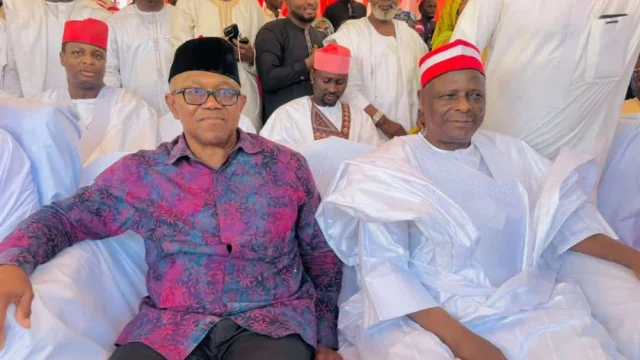
Fresh leadership disputes have unsettled the OK Movement, a political platform created to rally support for the joint presidential ticket of Nigeria Democratic Congress candidate Peter Obi and former Kano State Governor Rabiu Kwankwaso, exposing divisions within one of the opposition’s emerging support structures ahead of the 2027 general election.
The disagreement intensified after the movement announced the appointment of former Inter-Party Advisory Council Chairman, Peter Ameh, as its National Director-General in a statement signed by Jackie Wayas, who described herself as the movement’s National Convener.
Wayas said the appointment followed a steering committee meeting and was unanimously endorsed because of Ameh’s political experience and commitment to the movement’s objectives.
However, the announcement immediately drew resistance from some members, who questioned Wayas’ authority to speak as the group’s national convener. Efforts to obtain clarification from her were unsuccessful as calls and text messages were not answered.
The controversy exposed deeper divisions within the organisation, with rival camps making conflicting claims over its leadership.
Former National Publicity Secretary of the movement, Justin Ijeh, admitted that disagreements existed but argued they should be resolved internally.
“There are differences, but they should not be played out in the public. Our focus should remain on achieving victory at the polls,” he said.
Ijeh explained that he had stepped aside from his role pending the resolution of the dispute, noting that competing claims to the office of Director-General had complicated matters.
“I cannot continue as spokesperson when two people are laying claim to the same office. These issues need to be resolved first,” he added.
But the movement’s Director-General, John Ughulu, rejected Ijeh’s position, insisting the former spokesman had already been removed from office.
“Justin has been relieved of his responsibilities. He belongs to another group, and I decided to restructure the movement so we can move forward,” Ughulu said.
He maintained that the OK Movement was established as a long-term political platform designed to unite supporters of Obi and Kwankwaso without replacing their existing political structures.
According to him, there was an understanding that the platform would continue beyond the 2027 election.
“There was an agreement that the OK Movement would remain active beyond this election cycle. It was never intended to end after 2027,” he stated.
Ughulu also disclosed that Obi urged him to avoid taking the disagreement to the media.
“When this issue came up, Obi appealed to me not to go public with it,” he said.
He defended his decision to keep the leadership of the Obidient Movement separate from the OK Movement, arguing that merging both structures would create unnecessary conflicts.
Ughulu further alleged that some members attempted to undermine his leadership while portraying him as working against Obi’s political interests.
He explained that the movement was conceived to expand Obi’s support base beyond the Obidient Movement and attract Nigerians from different political backgrounds.
The Director-General also defended his decision to remove Ijeh, accusing him of acting beyond his responsibilities by promoting narratives that portrayed him as being hostile to members of the Obidient Movement.
He equally recounted his fallout with Jackie Wayas, alleging disagreements over fundraising and internal administration after the movement was established.
Meanwhile, another controversy emerged after social media reports claimed Obi had removed the National Coordinator of the Obidient Movement Worldwide, Dr Yunusa Tanko, over alleged financial misconduct.
Tanko dismissed the reports as false.
“There is nothing like that. I don’t even operate a separate account, and I’m not a signatory to the movement’s account,” he said.
He also denied reports of tension between the Obidient Movement and the OK Movement.
“We are simply working together. There is no crisis between us,” Tanko stated.
Obi’s media aide, Idris Zekeri, also rejected the claims, describing them as fabricated attempts to create disunity within the movement.
He urged supporters to disregard rumours, including reports alleging Tanko’s removal, insisting that political opponents were deliberately spreading misinformation to distract the opposition.
Former spokesman of the New Nigeria People’s Party, Ladipo Johnson, acknowledged that disagreements existed but dismissed suggestions that they posed a serious threat to preparations for the 2027 election.
Johnson described the dispute as a temporary distraction and revealed that Obi had expressed displeasure over the situation during a recent meeting.
Despite repeated assurances from leaders of both the Obidient Movement and the OK Movement that the disagreements would be resolved internally, the public exchange of accusations has heightened concerns over unity within a support platform expected to play a key role in opposition mobilisation ahead of the 2027 presidential election.