The National Universities Commission (NUC) has issued new guidelines to regulate the award and use of honorary doctorate degrees in Nigerian universities, following concerns over widespread misuse and indiscriminate conferment.
In a public notice, the Commission explained that the rules were approved under the Education (National Minimum Standards and Establishment of Institutions) Act, CAP E3, Laws of the Federation of Nigeria, 2004, and aim to preserve academic integrity and protect the global reputation of Nigerian universities.
Executive Secretary Abdullahi Yusufu Ribadu stated that the framework aligns with established academic traditions, including the Keffi Declaration of 2012, and is intended to strengthen institutional practices and ensure transparency.
The guidelines specify that only accredited universities that have graduated their first set of PhD students may award honorary doctorates, and awards must recognize exceptional contributions while reflecting institutional values. Self-nominated candidates and serving public officials are excluded.
Recipients are prohibited from using the title “Dr.”, supervising research, practicing professionally, or overseeing administrative units based on the honorary degree. Universities must provide orientation on proper usage, publish recipients’ names online, and have a formal mechanism to revoke awards for unethical conduct.
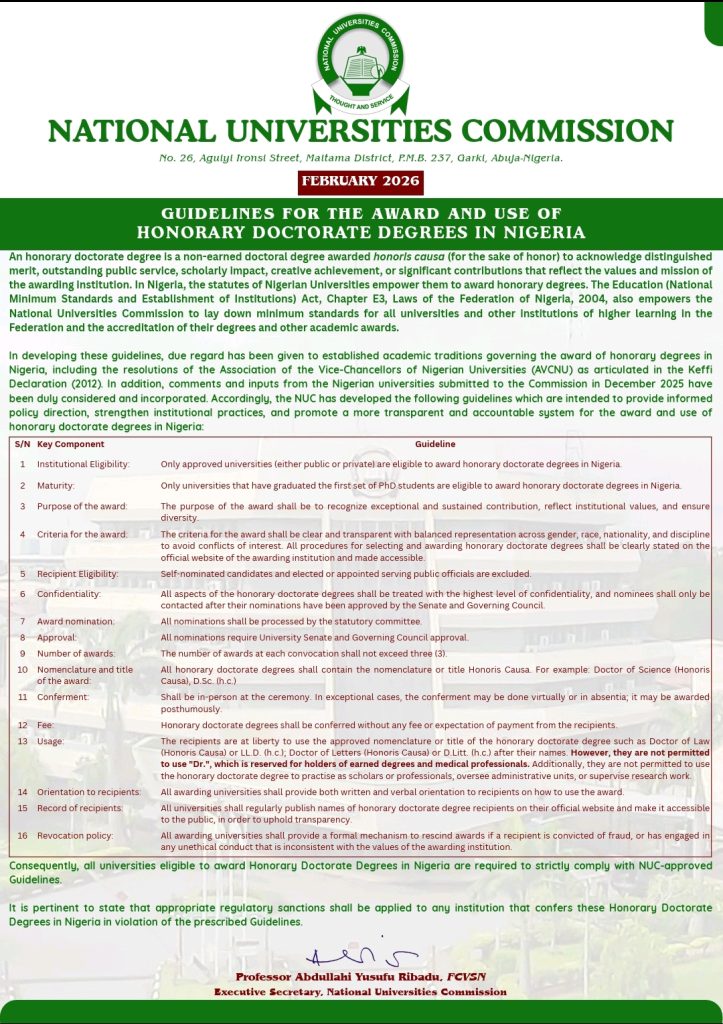
The NUC warned that violations would attract regulatory sanctions, emphasizing that honorary doctorates are honorary distinctions and not equivalent to earned academic or professional degrees.
The guidelines follow an investigation revealing that 32 institutions, including unaccredited foreign universities and unlicensed local bodies, were operating as honorary degree mills in Nigeria.